How to manage appointments in a car workshop
A practical guide to building a workshop booking diary around real capacity, asking the right questions on the phone and cutting down on no-shows.

6 min read
On this page
Monday, nine o'clock: four cars are waiting at the door. Two have appointments, one driver says they were "just passing", and the fourth told someone on the phone on Friday that they would come in on Monday, but nobody wrote it down. By eleven, one technician is sitting idle waiting for a part while another is trying to finish three jobs at once.
In the afternoon the picture flips. The two o'clock appointment doesn't turn up and nobody rings. A bay stands empty for an hour, and by evening two customers are standing at the service desk saying they have been waiting since the morning.
This post covers how to build your booking diary around the workshop's real capacity, what to ask when you take a booking, how to cut down on no-shows and how to make room for walk-ins.
Why does appointment management matter?
Appointment management means spreading the incoming work across the day so that your technicians and bays can actually get through it. A well-built diary pays off in three ways:
- The technician's day stays even. No morning pile-up followed by an empty afternoon; long jobs and short jobs share the day sensibly.
- Customers don't wait. A customer who arrives on time gets checked in on time. A customer left waiting tends to try another garage next time.
- You prepare in advance. If you know why a car is coming in, the parts can be ordered the day before and the right technician lined up.
An appointment is not just a time slot. It means knowing who is coming, in which car, for what job, and roughly how long that job will take.
Build the diary around your capacity
Before you fill the diary, know how much work you can really get through in a day. You don't need a complicated formula; a few honest answers are enough:
- How many technicians and how many bays do you have? If you have more technicians than bays, the bays are your limit; if fewer, the technicians are.
- How long do your most common jobs take? Write down your own average times for servicing, brakes, timing belts, air conditioning and so on.
- How much of the day goes on unplanned work? Breakdowns, recovered vehicles and warranty comebacks take some time every day.
These answers tell you how many hours of bookings each day can hold. Don't fill the diary to the brim; leave room every day for unplanned work. A gap in the morning and another in the afternoon lets you take an urgent job without moving anyone else's booking.
What should you ask when you take a booking?
A booking taken on the phone is the first step of the check-in; the more you write down then, the less you have to ask in the morning. For every booking, ask for:
- Customer and phone number. If someone other than the owner will bring the car in, their name and number too.
- Registration, make and model. These usually decide which parts you need and how long the job will take.
- Reason for the visit. A service, a fault, a check before the vehicle inspection? For a fault, a short description in the customer's own words.
- Whether the car will stay. A customer who waits needs a short job slot; a car left for the day can take a longer one.
Have every service adviser ask these questions in the same order. Even a short printed list removes the morning question of "who took this booking, and what was it for?"
At the end of the call, tell the customer the time and the rough duration plainly. "Come in at nine, it should be ready around midday" lets them plan their day, and keeping that promise builds trust.
How do you reduce no-shows?
The most effective way to prevent no-shows is to remind customers of their appointment and to record the ones who don't come. A few habits go a long way:
- Ring the day before. A short call reminds a customer who has forgotten. If they can't make it, you can give the slot to someone else.
- Don't book too far ahead. An appointment weeks away is easier to forget. Offer an earlier day where you can.
- Mark no-shows. Record when a customer misses their appointment. If the same customer does it often, remind them earlier next time.
- Set a limit on lateness. Decide in advance how late a customer can be before the slot goes to another car, and tell them when they book.
A missed appointment is rarely bad faith; most of the time the customer simply forgot. A reminder and a clear time close most of these gaps.
Make room for walk-ins
Rather than turning a walk-in away, open their check-in straight away and fit them into the first free slot in the diary. A customer at your door has already chosen your workshop.
What to do for this customer is clear:
- Find the car by its registration; if it isn't on record, add the car and the customer there and then.
- Write down the complaint and the request, and record the car's condition on the check-in form just as you would for a booked customer.
- Tell them honestly when you can start and when it will be done. If it won't be today, give them a time tomorrow.
This is where the gaps you left in the diary earn their keep. If there is no gap, telling the customer how long they will wait is better than saying "about an hour" and finishing in the evening.
Don't ask again at check-in
The appointment and the check-in are two ends of the same record; what was taken at booking should carry over when the customer arrives. Asking again at the door for the registration, name and complaint already given on the phone wastes time and makes the customer feel forgotten.
What is left for the service adviser at check-in is what the booking didn't cover: mileage, the car's condition, damage, photos and anything the customer wants to add. We walk through the check-in step by step in the vehicle check-in form guide. How to run the job after check-in is the subject of the work order guide.
Common mistakes
- Filling the diary to 100 per cent. Unplanned work arrives every day; a diary with no gaps falls apart at the first urgent job.
- Keeping bookings in a notebook or in someone's head. When the service adviser is off, nobody knows about the appointment.
- Giving a time without asking about the job. A one-hour service and a full-day timing belt job don't take up the same slot.
- Not recording no-shows. Without a record you can't tell which customers need an earlier reminder.
- Turning walk-ins away. Even if there's no room today, a time tomorrow is better than losing the customer.
Appointment management in Coudy Garage
In Coudy Garage, appointments sit in the calendar, for registered customers and first-time visitors alike. When the customer arrives, the check-in starts from the appointment in one click, and no-shows are marked. The day's appointments show in the home page's hour-by-hour plan, and upcoming appointments arrive as notifications for the team.
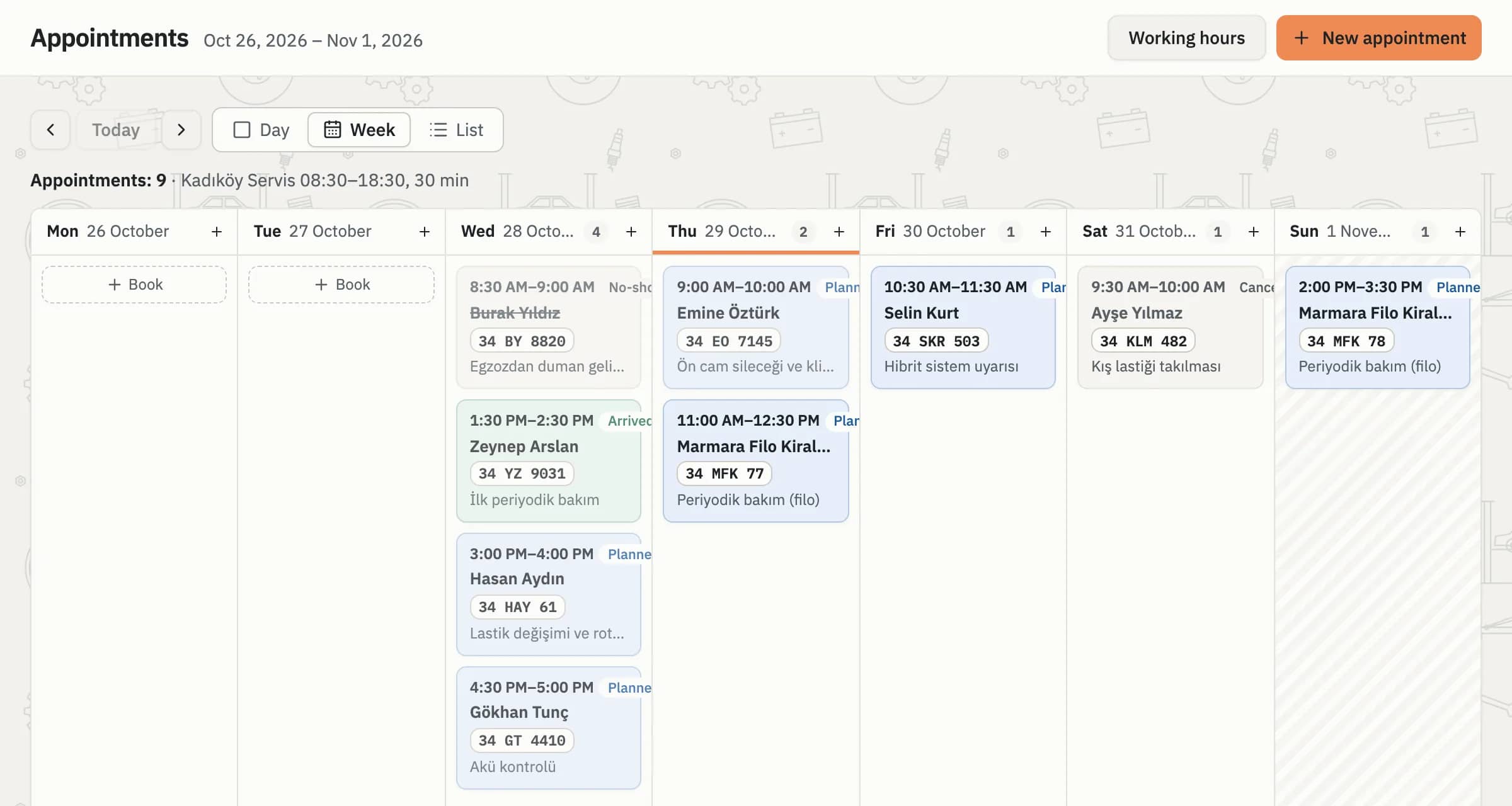
Appointments in Coudy Garage: arrivals move to check-in, no-shows are marked.
A walk-in customer's check-in opens directly; the car is found by its registration or added if it has no record. After check-in, the work order, promised delivery time and invoice all follow the same record. For more, see the Service and Check-in page.